Member Login





Advanced Simulation and Hi-Speed Cloud Computing Enables UPNM to Realize Large-Scale Metamaterial Lens Antenna Design Development.
2026.03.02
Background
Designing high-frequency antennas at millimeter-wave bands is never an easy task—especially when the structure is electrically large and computationally demanding. Researchers at Universiti Pertahanan Nasional Malaysia (UPNM) faced exactly this challenge while developing a 200 mm metamaterial lens antenna operating at 28 GHz, a frequency band critical for next-generation wireless and radar applications. They implemented Ansys HFSS high-frequency electromagnetic simulation software and CYBERNET CAE Cloud to overcome key computational challenges.
The Challenge:
|
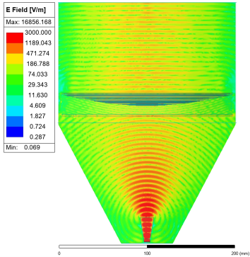
Fig. FE-BI Boundary Condition
|

The Solution
- Ansys HFSS – high-frequency electromagnetic simulation software.
- CYBERNET CAE Cloud – high-performance computing (HPC) cloud server.
CYBERNET enabled full-boundary simulations by providing HFSS software and lending their high-performance computing server. This allowed researchers to validate the accuracy of the FE-BI method against full radiation results, achieving reliable outcomes with a significantly more efficient simulation workflow.
"The continued adoption of HFSS with FE-BI is expected to play a key role in supporting sustainable, high-impact electromagnetic research and technology development across both academic and industrial sectors.”
Ts. Dr. Izni Husna Idris
Lecturer, Universiti Pertahanan Nasional Malaysia (UPNM)
About UPNM
|
|
Universiti Pertahanan Nasional Malaysia (UPNM) is a public defense university in Malaysia, focusing on advanced research and education in engineering, science, and defense-related technologies. |